
Knowledge Hub · Sleep Comfort
Sleep comfort with dust mite allergy: medical allergen protection that feels good every night
A good allergy encasement has to do two things at once: reliably hold back dust mite allergens and preserve a pleasant bed microclimate. Only both together create protection you actually use every night.
What does sleep comfort with dust mite allergy mean?
The answer in 90 seconds
Sleep comfort with dust mite allergy is not a wellness topic but a medical factor of use: an encasement protects only on the nights it is used — and it is only used if it does not disturb you in bed. What matters here is not how it feels in the hand. An encasement lies beneath your regular bedding; your skin never touches it directly. What counts is whether the barrier, breathability, quietness, wash resistance, and bed microclimate work together in the real sleep system. Allergocover combines protection and bed microclimate through a tightly woven, uncoated material that acts as a barrier without feeling like a plastic film.
Six points that really matter
- An encasement is an extra layer of bedding — you do not sleep on it. The cover lies between the mattress and your regular bedding, not against your skin. Allergology literature describes the encasement as an extra layer over the mattress, pillow, and duvet — in addition to the regular bedding. You sleep on the sheet above it; the direct feel of the encasement surface is secondary in bed.
- The "textile feel" is the wrong purchasing criterion. Because the cover lies beneath the bedding, how it feels to the touch is secondary. Four other parameters are perceptible: bed microclimate, noise, weight, and antistatic behavior. A soft feel says nothing about any of them — and nothing about the protective effect.
- Protection and bed microclimate have to work at the same time. An encasement may be impermeable to allergens without becoming impermeable to air and water vapor. A film would be impermeable but would burden the bed microclimate. A tightly woven, uncoated textile uses a size difference: water vapor passes through the fine pores, while much larger mite allergens are held back.
- Comfort decides the actual effect. An encasement only works on the nights it is used. An avoidance measure reduces exposure only with consistent use. A stuffy bed microclimate, rustling, or weight lower acceptance — a cover left in the closet has no effect.
- A soft "soft" feel is not proof of protection. A soft finish changes the surface — whether the barrier is preserved must be shown with product-specific evidence. As long as there is no product-specific proof that the barrier, seam, and wash resistance are preserved, a soft feel is a comfort promise — not proof of protection.
- What matters is the tested, even, and lasting barrier. Material names or brand names do not prove a medical protective function. What counts is whether the finished system holds allergens back — evenly across the surface, at the seams and zipper, and even after many wash cycles. For the Allergocover mattress encasement, Stiftung Warentest assessed protection, sleep climate, and lying comfort together.
Why dust mite allergy disrupts sleep
House dust mite allergy is not a seasonal condition. Unlike pollen, mite allergens are present in the home all year round — and exposure is densest in the bed.
What triggers the allergic reaction is not the mite itself — and not the house dust either. It is a protein from mite feces. The main allergen, Der p 1, is a digestive enzyme (a cysteine protease) and is concentrated in microscopic fecal pellets of roughly 10–40 µm. House dust is only the carrier here: it binds these allergen-laden particles, which are stirred up with every movement and reach the airways. That it is the feces — not the animal — that is the decisive allergen source was shown by Tovey, Chapman, and Platts-Mills back in 1981 in Nature (DOI 10.1038/289592a0).
This allergen protein is remarkably stable: in house dust it survives for years, and even high temperature and humidity over a year and a half barely change its concentration (PMID 7584689) — heat alone cannot reliably destroy it. That is exactly why a physical barrier is the logical measure: the allergen cannot be "heated away"; it has to be separated from the breathing zone and washed out.
One point is key to understanding this: the process is not a one-time event but a cycle that renews itself night after night. Anyone who understands it can also see where an encasement intervenes — and why the construction of the cover decides the outcome.
An allergic rhinitis does not only cause symptoms during the day. Allergology guidelines — in particular the ARIA classification (Allergic Rhinitis and its Impact on Asthma) — link it to reduced sleep quality and increased daytime fatigue. A systematic review with meta-analysis (Liu et al. 2020, PLoS ONE) evaluated 27 observational studies and found, on average, poorer sleep quality, longer time to fall asleep, and lower sleep efficiency in allergic rhinitis. Anyone who wakes up with a blocked nose experiences this connection directly.
With house dust mite allergy, the bed is not just another piece of furniture. It is the space where exposure and recovery meet head-on.
From this follows a simple logic: if allergen exposure is especially high during sleep, an avoidance measure can do the most exactly there. A medical encasement places a tightly woven barrier between the allergen reservoir in the bed and the airways — it interrupts the cycle at the source and so touches sleep comfort directly. This carries no promise of a cure; it can reduce nighttime exposure and so encourage calmer sleep, but it does not replace medical treatment.
Mattress, pillow, duvet — one connected system
When people think of an encasement, they first think of the mattress — from an allergology point of view, that falls short. The bed is a system of three components, each with its own role in allergen exposure.
The mattress is the long-term reservoir: large, hard to clean, in use for years. The pillow lies right next to the mouth and nose — the component closest to the breath. The duvet moves a great deal at night and is repeatedly thrown back when turning over, which stirs allergens up.
That the components count together has been studied clinically: in a study of children with asthma and mite allergy (Halken et al. 2003), encasing the mattress and the pillow lowered the allergen concentration over the long term and reduced the need for inhaled steroids. The clinical Allergocover study also used the complete set of bedding — a mattress encasement alone does not reflect this standard.
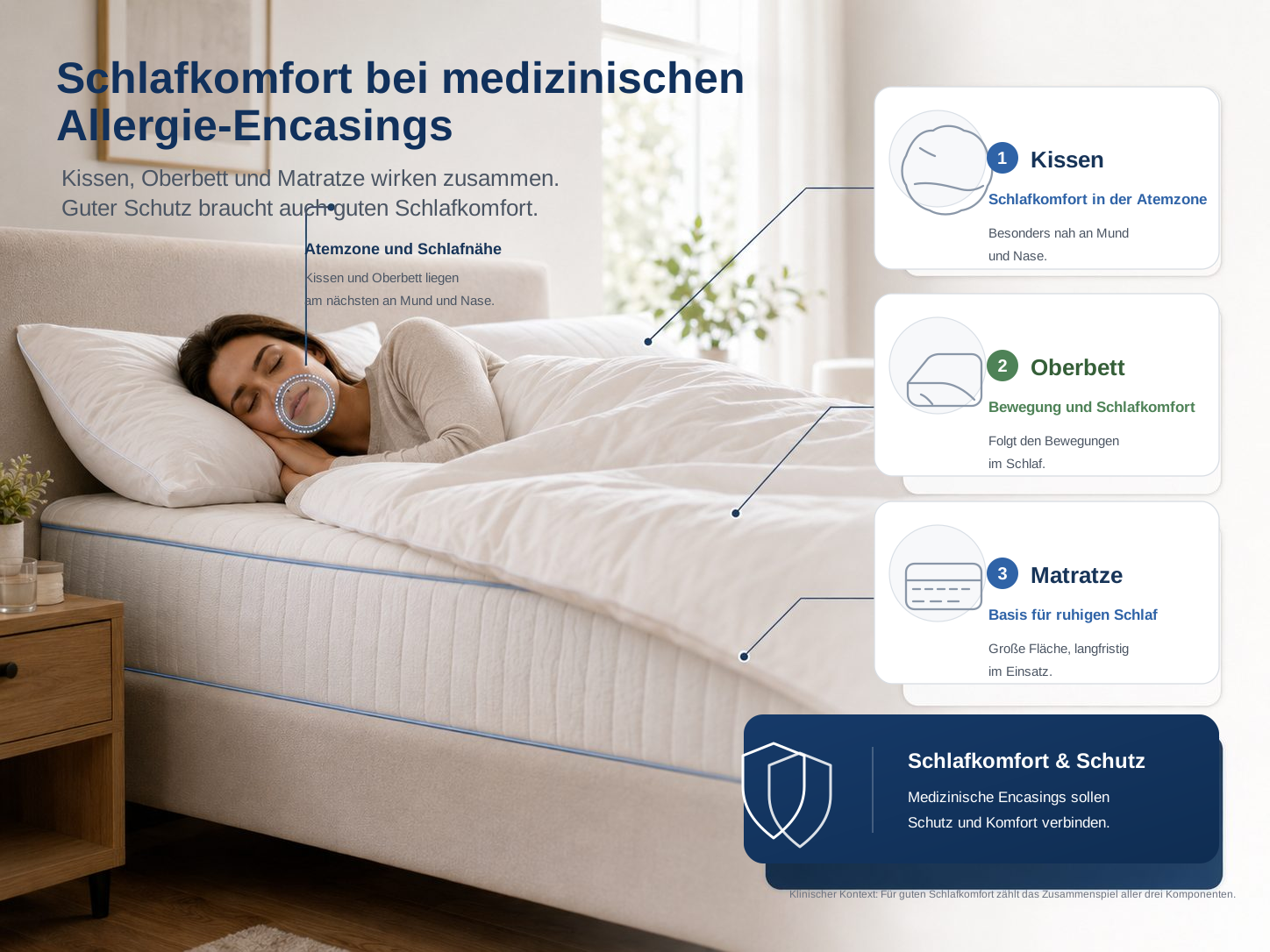
The graphic makes the core visible: sleep comfort with a dust mite allergy does not arise from a single component, but from the interplay of pillow, duvet, and mattress. The pillow lies in the breathing zone, right at the mouth and nose — here a complete, breathable encasement has the most direct effect on a calm night. The duvet follows every movement during sleep; an encasement that does not rustle and does not weigh it down does not disturb the night's rest. The mattress is the large, long-term base and the lasting allergen reservoir.
From this follows the answer to the question of which encasement you sleep best with: one that fully encloses all three components and combines protection and comfort — a closed allergen barrier together with a good bed microclimate, low weight, and a quiet surface. A single mattress encasement does not reflect this system. Allergocover is designed exactly for this, as a complete sleep system.
What an encasement really is: an extra layer of bedding
Before you can talk about comfort, one thing has to be clear — and advertising almost always skips over it: an encasement is not a bed sheet, but an extra layer worn underneath.
The allergology literature explicitly describes the encasement as an under-layer. It wraps the mattress, pillow, and duvet in addition to the regular bedding — so it lies beneath the fitted sheet, pillowcase, and duvet cover. You sleep on the regular bedding above it; the encasement surface normally does not touch the skin.
This unremarkable fact changes everything that is said about comfort afterward. If the skin does not touch the encasement, "How does the cover feel?" is the wrong question. The right one is: "What do I perceive of this cover at all — and how do I tell that it protects?"
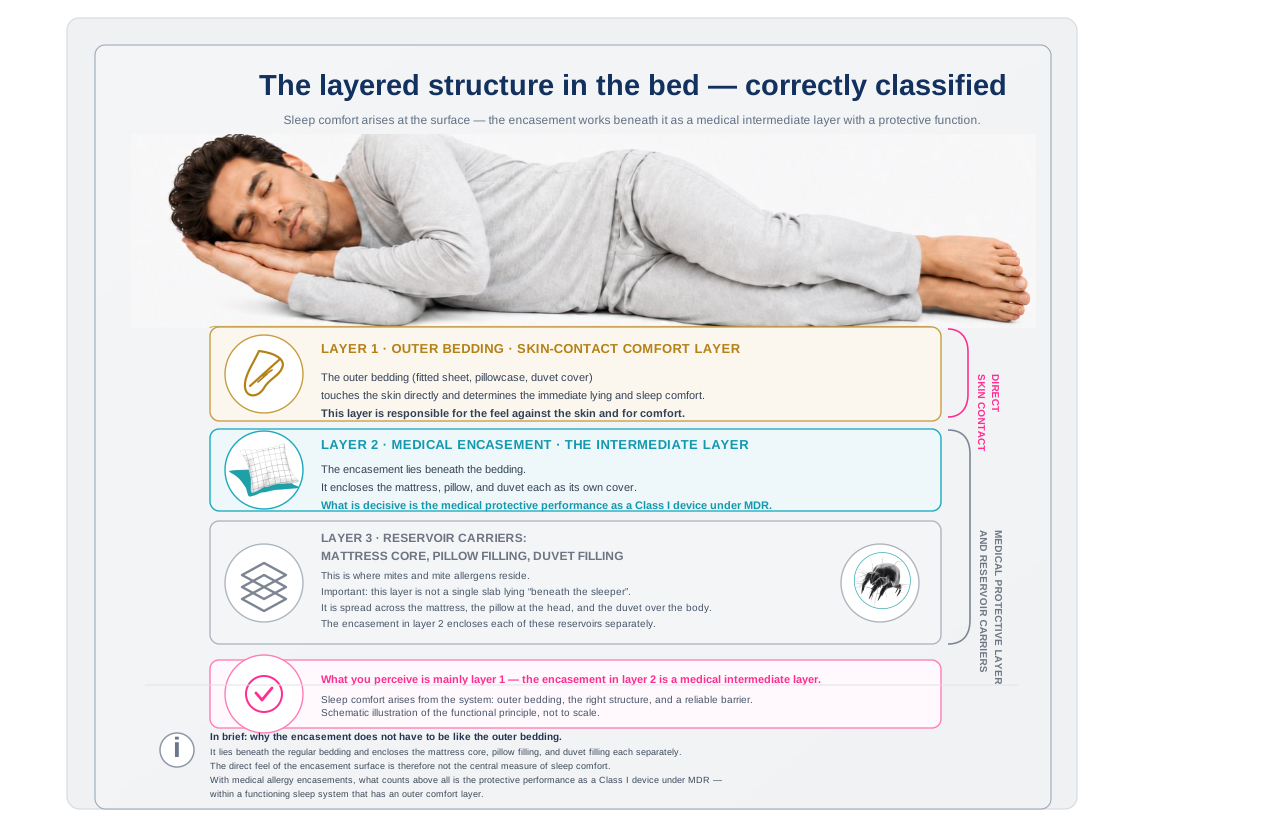
One detail underlines its role as an intermediate layer: a medical encasement should be antistatic — not for comfort reasons, but so that the bedding above it does not cling to it. It is therefore deliberately built to behave unobtrusively toward the actual bedding. A cover whose job is to go unnoticed is not judged by how it feels to the touch.
The textile trap with nonwoven encasements: or the misunderstanding about the "textile feel"
For many allergy sufferers, the wrong purchase begins in the store — with a hand on the fabric. It feels soft, so it seems high quality. But the touch tests exactly the one feature that no one feels during sleep.
Some providers deliberately advertise the "textile feel" — a soft, fabric-like touch, as if that were a quality feature of an encasement. That confuses a sales argument with a property of use.
The softness you check with your fingers in the store is secondary — the encasement lies beneath the regular bedding and, during sleep, is not experienced directly on the skin like a sheet. Other properties are perceptible: bed microclimate, noise, weight, and antistatic behavior. Those are what count.
There is even a physical disadvantage. The open, rough fiber structure that creates the soft "textile feel" of a nonwoven is at the same time a surface on which feces-laden dust settles. Since people are not allergic to the dust but to the allergen protein in mite feces — and the dust binds exactly this protein — a nonwoven cover collects the allergens right where it lies: with the pillow, directly in the breathing zone (Miller et al. 2007). A tightly woven, smooth encasement gives this buildup nothing to hold on to. The supposed softness is therefore not just irrelevant — it can work against the actual task.
What the study evidence says
For two of these four properties the evidence is clear. Weight and antistatic behavior are matters of everyday experience — noise and bed microclimate, by contrast, are documented by measurement.
Noise is not a comfort detail but a sleep factor. The systematic review of nighttime noise prepared for the WHO environmental noise guideline (Basner & McGuire 2018) shows: noise during sleep fragments it, triggers waking reactions, and shifts it into lighter, less restful stages. One finding from it is decisive — you get used to consciously hearing a noise, but the objectively measurable sleep disturbance remains. A cover that rustles with every movement therefore keeps disturbing sleep, even if you no longer notice the rustling after a few weeks.
The bed microclimate decides whether a cover stays bearable in continuous use. Allergology information from the American College of Allergy, Asthma & Immunology classifies the cover types clearly: vinyl and film-coated encasements let neither air nor water vapor through and are unpleasant to sleep on — a tightly woven, uncoated microfiber lets water vapor pass. Since a sleeping person gives off a considerable amount of moisture per night, it is exactly this permeability that decides whether the bed feels damp and stuffy.
Conversely, the touch predicts nothing about protective performance: two encasements can feel identically soft and still differ considerably in fabric density — and thus in barrier effect. That inconsistent encasement study results are partly due to the differing quality of the covers used is also noted in the allergology review by Klimek et al. (2023).
Choosing an encasement by its touch is like choosing a bicycle helmet by its color — nice if you like it, but meaningless for protection.
This does not mean an encasement is allowed to feel bad — there is nothing wrong with a pleasant material. It only means: the touch is not a quality criterion; it does not separate a good encasement from a bad one. The bed microclimate does that on the comfort side, and the barrier on the protection side.
Why comfort is the medical point
Comfort with an encasement sounds like a soft side topic — a matter of feeling good, not of medicine. In fact it is the other way around: comfort is the condition under which the medicine works at all.
An encasement is an avoidance measure. It reduces nighttime allergen exposure — but only on the nights it is used. A cover that rustles, makes the bed stuffy, or is heavy gets taken off. And an encasement that has been taken off has an effectiveness of zero — no matter how well its barrier performs in the lab.
Protection that no one wants to sleep on is not protection. It is an unused piece of textile in the linen closet.
This turns comfort from a sideshow into a core medical criterion. The chain of effect is short and compelling:
The steps build on one another: the effect of an encasement documented in studies only occurs if the cover is actually used night after night. Whether an encasement has a good bed microclimate, is quiet, and is pleasantly light decides whether it is used. These properties are therefore not a comfort add-on next to the medicine — they are part of the effectiveness.
The bed microclimate — the comfort you actually feel
What you genuinely feel during sleep is the bed microclimate — and it is closely tied to the protective function. An encasement has to do two jobs at once: hold house dust mite allergens back and let air and water vapor pass through.
These requirements seem to contradict each other, but a difference in size resolves them: allergen-carrying particles from mite feces are microscopic, yet large in physical terms — a water vapor molecule is smaller by orders of magnitude. A tightly woven, uncoated encasement uses exactly this: its pore structure blocks the large allergen particles and lets water vapor through. Vaughan et al. (1999) confirmed this by measurement — fabrics with pores below 10 µm held Der p 1 and Der f 1 below the detection limit — and at the same time showed the trade-off: the smaller the pores, the more air permeability can drop. A good encasement is therefore not "as tight as possible," but built right where the barrier and the bed microclimate still work together.
"Breathable" is not an advertising word here but something measurable — by a defined procedure. For medical allergy encasements, breathability is tested on a skin model (the "sweating guarded-hotplate" method per EN 31092): a plate heated to 35 °C simulates evaporating sweat, and the measurement records how well the textile carries this water vapor away. This procedure, recognized by TÜV Nord, also underlies the quality requirements for the German medical-aids register (Hilfsmittelverzeichnis) — unlike the older "cup model," which a court rejected as scientifically inadequate back in 2011 (Regional Court of Schwerin, 2011, final and binding). From this come concrete, verifiable threshold values:
Verifiable parameters for a healthy bed microclimate
Water vapor permeability
of the lying surface > 4,000 g/m² in 24 h — so that nighttime sweat can escape.Type of evidence: technical test criterion
Air permeability
of the lying surface > 3 l/(dm²·min) — per the DIN EN ISO method at defined pressure differentials.Type of evidence: technical test criterion
Sweat transport
index value > 765 g/m² — describes how well moisture is carried away from the body.Type of evidence: technical test criterion
Physiological comfort value
overall value ≤ 3.5, skin-sensory ≤ 2.5 — a climate-comfort index determined via a skin model.Type of evidence: technical test criterion
It is exactly at these thresholds that the difference between the material types shows. The allergology literature is clear: woven, uncoated textile is generally more breathable than nonwoven material (Klimek et al., Allergo J 2024). A nonwoven is created by bonding fibers mechanically or hydrodynamically into a sheet — this gives good filter properties, but uneven layer thickness and irregularities across the surface. A tightly woven textile, by contrast, is made from even lengthwise and crosswise threads and produces a consistently defined, uniformly dense structure — verifiable against the parameters above.
For the consumer this has a concrete consequence: breathability is not a comfort luxury. For people who sweat heavily and for people with atopic dermatitis (eczema), a well-breathing textile is a therapeutic advantage — it helps prevent moisture buildup, eczema flares, and itching. An encasement that meets the skin-model parameters holds the allergens back and lets nighttime sweat escape. A cover whose bed microclimate is not documented against these values cannot guarantee both — protection and climate — at the same time. The question to ask of any product is therefore not "does it feel soft?" but "are the climate parameters tested on a skin model?"
The threshold values named here are the quality criteria established for medical allergy encasements and verifiable on the TÜV Nord skin model — the basis, among other things, for the requirements of the German medical-aids register. They are standard criteria, not product-specific measurements from this page. Allergocover is a tightly woven, uncoated encasement and is therefore designed for exactly these requirements.
The four comfort parameters — and the one that carries everything
Sleep comfort with an encasement is made up of four perceptible parameters. Each has a physical cause and is verifiable. Above all of them stands a fifth criterion that is not itself a comfort feature, but decides whether the other four count at all: the barrier.
1 · Bed microclimate
The breathability and water vapor permeability of an uncoated fabric. Felt as a pleasant, non-stuffy sleep climate — the only comfort parameter you perceive indirectly through the skin.
Physics / biology · verifiable via skin model
2 · Noise
An encasement should not rustle when you move. Rustling carries through the thin sheet and disturbs sleep — it is one of the most common reasons a cover is taken off again.
product-specific / technical
3 · Weight
A lightweight fabric is easy to fit and does not make the duvet heavy. Technical criteria name an upper limit of around 100 g/m² for the encasement material.
product-specific / technical
4 · Antistatic behavior
An antistatic fabric — in Allergocover via a woven-in carbon thread — keeps the regular bedding from clinging to the encasement and slipping out of place.
product-specific / technical
Overarching · The barrier
The four comfort parameters decide how an encasement is experienced. Whether it protects is decided by the barrier: an even, lasting, complete allergen-tightness across the surface, the seam, and the zipper. A cover without this barrier is not a medical encasement — no matter how good the four comfort values are.
Precondition · without the barrier, comfort does not count
This structure is the core of the page: four perceptible comfort parameters, one overarching protective function. Anyone evaluating an encasement checks these five points — everything else is a sales pitch.
Everything at a glance — the ordered comparison
The individual arguments can be brought together in one table — a tightly woven encasement against a nonwoven encasement and its softened "soft variant," with each row giving the criterion, both options, and the type of evidence.
| Criterion | Tightly woven encasement | Nonwoven encasement & "soft variant" | Type of evidence |
|---|---|---|---|
| What the skin touches | None of it — the encasement lies as an intermediate layer beneath the regular bedding. | Also none of it — true for any encasement. The advertised soft feel therefore has little relevance in use. | Specialist literature / definition |
| Surface | Smooth, tightly interwoven — unchanged even after many washes. | Fibrous; deliberately roughened by the soft treatment. | Material logic / manufacturer comparison |
| Behavior when washed | The weave structure stays stable in the wash; no roughening, no loss of material. | Pre-treatment and washing can change the surface and fiber structure. | Allergology literature |
| Grip for mites | A smooth surface offers barely any fibrous footholds. | Rough fiber structures tend to give arachnids more grip than smooth fabrics. | Biology / specialist literature |
| Barrier across the surface | Even pore geometry; no structural allergen gaps. | Pore size can vary by production method; evenness must be proven for the specific product. | Trade-association article, Allergo Journal 2024 |
| Bed microclimate | Uncoated, breathable, water-vapor-permeable. | Woven, uncoated textile is considered generally more breathable than nonwoven material. | Allergology literature |
| Recommended wash frequency | As needed, washed at 60 °C, no restriction. | Sometimes recommended only about 2× per year — a restriction for material reasons. | Manufacturer information / specialist literature |
| Clinical evidence | Product-specific clinical study available (Brehler / Kniest 2006). | For simple discount-store allergy bedding, product-specific studies are usually not available. | Clinical evidence |
Source basis: allergology literature and the trade-association article "Quality criteria of encasings" (Allergo Journal 2024). Statements about "nonwoven" refer to the material-typical behavior of nonwoven materials; not every commercial brand was tested individually.
Briefly on the evidence — what the comfort is built on
This page explains sleep comfort, not the body of studies in full depth — the evidence matrix at the end assigns the central studies to their type of evidence, and the technical material question is explored in depth by the Allergocover material comparison. For the comfort topic, one physical foundation matters above all: why the barrier has to be fine and breathable at the same time.
Why the barrier has to be fine and even
Mite allergens are attached mostly to larger particles — above all to mite feces. An effective barrier must reliably hold these large particles back and at the same time be fine enough to also catch the smaller, respirable fraction — and do so without gaps across the whole surface. This is exactly where a tightly woven fabric parts ways with a nonwoven, whose pore size varies across the surface.
Why the feces break apart in the bed — and what that means
A mite fecal pellet of around 22 µm is many times larger than the required pore — so why must the barrier be so fine? Because the pellet does not stay whole in the bed. It is a fragile structure held together by mucus, and it breaks apart through moisture and through the pressure and friction of the sleeper's movement — the so-called kneading motion — into much smaller, respirable fragments. The barrier therefore does not have to hold back the whole pellet but its fragments. Hence the pore size required by specialists of ≤ 0.5–0.75 µm.
From this follows a practical classification: the more pressure and friction act in the bed, the more completely the feces break apart — and the more moisture a sleeper gives off, the more the barrier has to carry away without becoming permeable to allergens. Body weight is a factor in both: more weight means more mechanical load on the bed and, as a rule, more perspiration. For heavier sleepers, a fine, even, and at the same time breathable barrier therefore counts especially. How a tightly woven fabric achieves this pore geometry technically — and why it varies across the surface in a nonwoven — is explored in depth by the Allergocover material comparison.
The measurable criteria of the barrier
From this come the barrier-side quality criteria that a medical allergy encasement must measurably meet. The allergology literature describes them concretely (Klimek L et al., Allergo J Int 2023;32:18–27; trade-association information, Allergo J 2024): a proven particle retention of ≤ 0.5–0.75 µm — and evenly so at every point of the surface, with no differences in layer thickness and no allergen gaps; a fabric weight of at most 100 g/m², so that the cover does not add bulk on top of the regular bedding; a covered, internal zipper flap with a concealed seam, because allergens otherwise pass through precisely at seams and closures; raw materials tested for harmful substances to STANDARD 100 by OEKO-TEX, product class I; and washability at at least 60 °C, without the warranty being tied to the number of wash cycles. Medical allergy textiles made of a tightly woven, uncoated fabric are designed to meet these criteria — Allergocover is one example of this, not a unique selling point. The technical depth on this — pore geometry, fabric density, and surface — is explored by the Allergocover material comparison.
The clinical evidence — each study with its result
Several studies on the clinical effect are available — here each with its concrete result, not as a blanket trend. In a double-blind, placebo-controlled study of 60 mite-allergic patients over twelve months (Brehler & Kniest 2006), medication use in the encasement group was around 46 % lower than with placebo covers. A randomized controlled study of children with asthma and mite allergy (Halken et al. 2003) found, after the mattress and pillow were encased, a long-term reduced allergen concentration and a lower need for inhaled steroids. In adult atopic asthmatics, microfiber-based covers reduced mite allergen exposure in the sleep system (Tsurikisawa et al. 2013).
Material studies fit the same logic: mites penetrated and colonized non-woven covers, but not tightly woven microfiber (Mahakittikun et al. 2006), and high allergen amounts were found on used nonwoven covers (Miller et al. 2007). The strength of the evidence varies with study design and sample size — the evidence matrix below assigns each of these statements to its type of evidence and its limit.
The technical material explanation of woven fabric and nonwoven material — pore geometry, fabric density, wash resistance — is explored in depth by the Allergocover material comparison.
To the material comparisonProtection and sleep — in one minute
Fig. 12 · Encasements in the sleep system. The covers enclose the mattress, pillow, and duvet and are then covered with regular bedding — as an intermediate layer that does not stand out further in everyday life.
Six points for your own choice
Anyone choosing an encasement can go by a few clearly verifiable points — and by one that should be deliberately ignored.
- Do not be led by the feel. An encasement advertised as "especially soft" optimizes a property that is secondary in bed — that is not proof of medical quality. If a nonwoven product is sold on softness, there should be product-specific evidence that the barrier and wash resistance remain unaffected.
- Ask about the bed microclimate. Breathability and water vapor permeability decide whether the bed becomes stuffy. Good providers name tested climate parameters instead of feel-good terms.
- Pay attention to noise and weight. An encasement should not rustle and should not make the duvet heavy — otherwise both lower the willingness to use it for the long term.
- Check the wash instructions. If washing only twice a year is recommended, that is a hint about the material, not a comfort advantage. An encasement should be washable at 60 °C as needed.
- Think about the whole bed. The pillow and duvet lie especially close to the airways; clinical studies work with the complete set — a mattress encasement alone does not reflect this.
- Ask for evidence, not labels. "Medical" or "test-proven" are not proof. Ask for a product-specific clinical study, tested particle retention, and details on wash resistance.
Note for professionals
Classification for medical advice
The acceptance of an encasement decides its real effectiveness as an avoidance measure: it works only with consistent nightly use — the bed microclimate, noise, and weight are therefore use-relevant criteria, not mere comfort questions.
On material assessment: a nonwoven variant marketed as "soft" usually gets its feel through a mechanical or wash-based pre-treatment. If this is turned into a quality argument, it must be shown for the specific product that the barrier performance, evenness, wash resistance, seam, and zipper remain unaffected. A low recommended wash frequency is also in conflict with the hygiene requirement for a permanent cover.
Allergology guidelines classify encasements as an avoidance measure within an overall concept. Diagnosis, indication, and treatment remain medical tasks; the product-specific clinical evidence and the material tests are listed in full in the Allergocover Medical area.
What this page refers to — and what it does not
This page deals with sleep comfort in house dust mite allergy and with the question of which properties of an encasement actually count in use. It is a knowledge page, not medical advice for an individual case.
Statements about "nonwoven" describe the material-typical behavior of nonwoven materials, particularly under a soft treatment; not every individual commercial brand was tested. Nonwoven encasements can be suitable as standard provision. The clinical figures named refer to the products and patient groups studied in each case and cannot be transferred unexamined to every product. The climate parameters named are professionally established quality criteria, not product-specific measurements. An encasement is a physical avoidance measure; it does not replace a medical diagnosis or treatment.
Global relevance: sleep comfort in an international context
Dust mite allergy and sleep-related complaints are not a local problem — and that is exactly what makes the topic robust.
House dust mite allergy, allergic rhinitis, asthma, and sleep-related complaints occur worldwide. Climate, humidity, housing conditions, and bedding culture differ by region — but the central question stays the same everywhere:
How can nighttime exposure to mite allergens in the bed be reduced without worsening sleep comfort?
For an encasement, this leads to a demanding requirement: it must work as a barrier not only in the lab, but in the real bedrooms of very different climate zones — warm and humid, a cold heating season, constant air conditioning. This is exactly where the bed microclimate goes from a comfort detail to a functional feature.
International studies show different facets of the same problem — classified here by what they prove and what they do not:
| Region | Evidence signal | Meaning for sleep comfort |
|---|---|---|
| Japan | Randomized study of atopic asthmatics (Tsurikisawa et al. 2013): microfiber-based bedding covers reduced mite allergen exposure. | Direct encasement evidence — supports the sleep-system logic beyond the mattress. |
| China | Studies of children link asthma and allergic rhinitis with sleep problems; house dust mites are a year-round source especially in southern China. | Context evidence — supports the medical focus and the role of the bed microclimate. |
| India | Work describes a high relevance of house dust mites and indoor allergens, especially in warm and humid regions. | Context evidence — supports the importance of breathable barriers in a humid climate. |
| USA | House dust mite positivity has been linked to sleep-related breathing parameters; guidelines recommend allergen reduction as part of a multi-component concept. | Context evidence — supports the sleep-medicine classification and a measured positioning. |
| Arabian Peninsula | Allergic rhinitis is widespread; with high outdoor temperatures, constant air conditioning and indoor moisture shape the bedroom microclimate. | Climatic context — supports the importance of water vapor management. |
| Europe | Guidelines and reviews discuss encasements for reducing mite allergen exposure — with differentiated evidence and clear quality requirements. | Guideline context — supports the classification as a medically plausible avoidance measure. |
Directly reviewed primary sources: Liu et al. 2020 and Tsurikisawa et al. 2013. The other regional statements summarize the body of studies, which is worked up with full sources in the Allergocover Medical area. None of these sources proves that Allergocover was clinically tested in a particular country.
The honest reading: international evidence does not prove that every encasement guarantees better sleep everywhere. But it does show that dust mite allergy, allergic respiratory diseases, and sleep quality are connected worldwide — and that a sleep system of a tested barrier, a good bed microclimate, and lasting use is plausible in every climate zone. That is exactly where Allergocover sleep comfort begins.
Evidence matrix — every statement with its origin
The matrix below assigns each key statement a type of evidence, the concrete source, and its limit. A physical logic is not clinical proof, and a manufacturer comparison is not an independent study — this difference is made openly here.
| Statement | Type of evidence | Source & logic | Limit |
|---|---|---|---|
| An encasement is an intermediate layer and lies beneath the regular bedding. | Specialist literature | Allergology literature and the trade-association article describe the encasement as an intermediate layer over the mattress, pillow, and duvet — in addition to the regular bedding. | None — a defining property of an encasement. |
| The direct feel of the surface is secondary. | Logic | The encasement lies beneath the bedding. What is perceptible is the bed microclimate, noise, weight, fit, and antistatic behavior — not the feel in the hand. | A pleasant material does no harm; it just does not separate a good encasement from a bad one. |
| A soft treatment of nonwoven material can change the surface and fiber structure. | Material logic | Mechanical or wash-based soft treatment changes the surface. Whether the barrier, seam, and wash resistance are preserved must be proven for the specific product. | Not a blanket statement against soft variants; without product evidence, "soft" stays a comfort promise. |
| Rough fiber structures can make it easier for mites to hold on. | Biology | Mites are arachnids with gripping organs and find more grip on roughened structures than on a smooth fabric (trade-association article, specialist literature). | Colonization builds up over weeks to months, not immediately. |
| Non-woven cover materials can be penetrated and colonized by mites. | Material study | Mahakittikun et al. 2006: mites penetrated and colonized non-woven and coated encasements, but not tightly woven microfiber. Miller et al. 2007: high allergen amounts on used nonwoven covers. | Laboratory assessments; valid for the material types studied, not every commercial brand individually. |
| Encasements can reduce allergen load and medication use. | Clinical evidence | Brehler / Kniest 2006: double-blind, placebo-controlled, 60 patients, 12 months — around 46% lower medication use. | Small sample size; no promise of a cure; specific to the product and group. |
| The bed microclimate is objectively verifiable; a dense fabric is breathable. | Test criteria | For medical encasements, climate parameters verifiable via a skin model are established (water vapor and air permeability). | Professionally established quality criteria, not product-specific measurements. |
| Mite allergens sit mostly on larger particles (mite feces, 10–40 µm); the pore size required by specialists, ≤ 0.5–0.75 µm, is below this. | Physics | In cultures, > 95% of Der p 1 is bound to fecal particles (Ø ~22 µm); in room air, > 80% sit on particles > 10 µm (Tovey 1981; De Lucca 1999; Custovic 1999). A pore ≤ 0.5–0.75 µm holds the entire spectrum back. | Studies on airborne allergen; a smaller fraction (~1–5 µm) is respirable and is also caught by a fine, even barrier. |
| Allergic rhinitis is associated with poorer sleep quality. | Meta-analysis | Liu et al. 2020 (PLoS ONE): systematic review of 27 observational studies — poorer sleep quality and efficiency in allergic rhinitis. | Observational studies show associations, not causation. |
| Bedding encasement can reduce mite exposure in the sleep system. | Clinical study | Tsurikisawa et al. 2013: randomized study of adult atopic asthmatics; microfiber-based covers reduced Der 1 exposure. | Small sample size; an international system signal, not Allergocover product proof. |
| Fabrics with pores below 10 µm hold mite allergens back — with decreasing air permeability. | Material testing | Vaughan et al. 1999: fabrics with a pore size < 10 µm held Der p 1 and Der f 1 below the detection limit; smaller pores lower air permeability. | Documents the barrier/bed-microclimate trade-off, not a product ranking. |
| A rustling cover disturbs sleep measurably — even without conscious perception. | Sleep medicine | Basner & McGuire 2018 (systematic review for the WHO environmental noise guideline): noise during sleep fragments it, triggers waking reactions, and shifts it into lighter stages. You get used to consciously perceiving the noise; the objectively measured sleep stays disturbed. | Evidence from studies on environmental and traffic noise; transferring it to bedding rustle is professionally plausible, but not a direct bedding-noise trial. |
| Film-coated (impermeable) encasements burden the bed microclimate through buildup of heat and moisture. | Professional information | Allergology information (American College of Allergy, Asthma & Immunology): vinyl- and laminate-coated encasements let neither air nor water vapor through and are unpleasant to sleep on; tightly woven, uncoated microfiber lets water vapor pass. | Describes material classes, not a product-specific measurement. |
| Two equally soft encasements can differ considerably in protective effect. | Professional information | ACAAI: woven microfiber encasements differ considerably in fabric density — and thus in barrier effect; the feel does not indicate this. Klimek et al. 2023 attributes inconsistent study results partly to the differing quality of the encasements used. | Confirms that the feel is not a quality criterion; does not replace a product-specific barrier test. |
| A wash at 60 °C is enough; a boil wash at 95 °C brings no additional allergy protection. | Material study | Park et al. 2008: 60 °C kills house dust mites completely; at 40 °C only around 2% of the allergen remains. McDonald & Tovey 1992: even a cold wash lowers the allergen by over 90%. The allergic trigger is the allergen, not the living mite. | Laboratory studies on washing. Heat-sensitive textiles do not benefit from 95 °C anyway — a tightly woven encasement is designed for 60 °C. |
| A tightly woven, uncoated encasement is more breathable than a nonwoven encasement. | Specialist literature | Klimek et al. (Allergo J 2024): woven, uncoated textile is generally more breathable than nonwoven. Nonwoven has uneven layer thickness across the surface; woven textile produces a uniformly dense structure verifiable on a skin model. | A material comparison from the literature, not a product-specific measurement comparison on this page. |
| The allergic reaction is directed at a protein in mite feces, not at house dust; this allergen is stable to heat and aging. | Biology | The main allergen Der p 1 is a cysteine protease in the fecal pellets (Tovey et al. 1981, Nature). House dust mite allergens are remarkably stable: high temperature and humidity over 1.5 years barely change the concentration (PMID 7584689). | Stability findings from climate and storage trials; they justify the barrier principle but do not prove the effectiveness of an individual product. |
Sources used
| Source | Reference & identifier | Type of evidence |
|---|---|---|
| Trade-association article: Avoidance measures in house dust mite allergy — quality criteria of encasings | Allergo Journal 2024;33(1) | Specialist article by an allergology association |
| Klimek L et al.: Caring measures for mite allergy — an update | Allergo J Int 2023;32:18–27 | Review article |
| Brehler R, Kniest F: Encasing study in mite-allergic patients — one-year, double-blind, placebo- and environment-controlled investigation | Allergy Clin Immunol Int – J World Allergy Org 2006;18:15–19 | Double-blind, placebo-controlled study (n=60) |
| Müller-Scheven D, Kniest F, Distler M, Hofman-Wecker M: Encasing investigation in house dust mite allergy | Allergologie 1998;21:534–540 | Retrospective investigation (n≈96) |
| Liu J et al.: Allergic rhinitis and its association with sleep — systematic review and meta-analysis | PLoS ONE 2020;15(2):e0228533 · DOI 10.1371/journal.pone.0228533 | Systematic review / meta-analysis |
| Tsurikisawa N et al.: Encasing bedding in microfine-fiber covers reduces house dust mite allergen exposure | Allergy Asthma Clin Immunol 2013;9:44 · DOI 10.1186/1710-1492-9-44 | Clinical study |
| Vaughan JW, McLaughlin TE, Perzanowski MS, Platts-Mills TA: Evaluation of materials used for bedding encasement — effect of pore size in blocking cat and dust mite allergen | J Allergy Clin Immunol 1999;103(2):227–231 · DOI 10.1016/s0091-6749(99)70495-1 · PMID 9949312 | Experimental material study |
| Halken S, Høst A, Niklassen U et al.: Effect of mattress and pillow encasings on children with asthma and house dust mite allergy | J Allergy Clin Immunol 2003;111(1):169–176 · PubMed-listed | Randomized controlled study (children) |
| Mahakittikun V, Boitano JJ, Tovey E, Bunnag C, Ninsanit P, Matsumoto T, Andre C: Mite penetration of different types of material claimed as mite proof by the Siriraj chamber method | J Allergy Clin Immunol 2006;118(5):1164–1168 · DOI 10.1016/j.jaci.2006.07.025 · PMID 17088144 | Laboratory study (materials) |
| Miller JD, Naccara L, Satinover S, Platts-Mills TAE: Nonwoven in contrast to woven mattress encasings accumulate mite and cat allergen | J Allergy Clin Immunol 2007;120(4):977–979 · DOI 10.1016/j.jaci.2007.06.048 · PMID 17854879 | Material study (letter) |
| ARIA — Allergic Rhinitis and its Impact on Asthma: classification and assessment of allergic rhinitis and sleep | International ARIA initiative | Guideline / classification document |
| Stiftung Warentest: test of encasings — protection against mite allergens, sleep climate, lying properties | Issue 3/2003 | Independent product testing |
| Manufacturer's classification document (Allergocover): medical encasement versus allergy bedding | Manufacturer document | Manufacturer comparison — not an independent study |
| Basner M, McGuire S: WHO Environmental Noise Guidelines for the European Region — Systematic Review on Environmental Noise and Effects on Sleep | Int J Environ Res Public Health 2018;15(3):519 · DOI 10.3390/ijerph15030519 · PMID 29538344 | Systematic review (sleep medicine) |
| American College of Allergy, Asthma & Immunology (ACAAI): Home Environment Control — material types, comfort, and barrier effect of allergen-proof encasings | ACAAI patient information · acaai.org | Professional information from an allergology society |
| Park JW et al.: Optimal conditions for the removal of house dust mite, dog dander, and pollen allergens using mechanical laundry | Ann Allergy Asthma Immunol 2008 · PMID 18592823 | Controlled washing study |
| McDonald LG, Tovey E: The role of water temperature and laundry procedures in reducing house dust mite populations and allergen content of bedding | J Allergy Clin Immunol 1992 | Experimental washing study |
| Toward sustainable household laundry — washing quality vs. environmental impacts | Int J Environ Health Res 2023 · DOI 10.1080/09603123.2023.2194615 | Review / life-cycle analysis |
| Klimek L et al.: Avoidance measures in house dust mite allergy — quality criteria of encasings ("Woven, uncoated textile is generally more breathable than nonwoven"; skin-model testing) | Allergo J 2024;33(1):62–63 | Specialist publication / quality criteria |
| Stability of house dust mite allergens (Der p 1, Der p 2) under natural conditions — barely any decrease in concentration after 1.5 years at high temperature and humidity | PMID 7584689 | Experimental stability study |
International studies refer to the products and patient groups studied in each case and are not product proof for Allergocover. The technical material explanation and the underlying body of studies are worked up systematically in the Allergocover material comparison and in the evidence matrix on this page.
Questions about encasements and sleep comfort
What does sleep comfort with dust mite allergy mean?
Sleep comfort with dust mite allergy does not mean a soft feel in the hand. An encasement sits as an extra layer between the mattress or pillow and your regular bedding, and is not touched directly during sleep. Comfort comes from the bed microclimate, a quiet surface, weight, and antistatic behavior — and it is the condition for the allergen protection to actually be used every night.
Can you feel an encasement in the bed?
Directly, hardly at all. You sleep on your regular bedding, and the encasement lies beneath it. It would only become noticeable through disturbances — rustling, a buildup of heat or moisture, or distracting stiffness. A good medical encasement stays unobtrusive for exactly that reason.
Why is a soft, textile feel a poor purchasing criterion?
Because the encasement lies beneath the bedding, and how it feels to the touch during sleep is secondary. A soft impression in the store says nothing about protective performance, bed microclimate, or wash resistance. What matters is whether the cover holds allergens back and does not disturb sleep — not how it feels in the hand.
Is a soft variant of a nonwoven encasement better?
A soft feel is not proof of medical quality. A soft finish is usually produced by mechanical or wash-based pre-treatment and can change the surface and fiber structure. If it is turned into a quality argument, there should be product-specific evidence that the barrier, evenness, and wash resistance are preserved. Rough, fibrous surfaces also tend to give mites more grip than smooth, tightly woven ones.
Why can house dust mite allergy disturb sleep?
Allergens from the mattress, pillow, and duvet are inhaled during the night. A blocked nose, sneezing, and an urge to cough lead to restless sleep and frequent waking. Review articles link allergic rhinitis to poorer sleep quality (Liu et al. 2020). An encasement reduces nighttime allergen exposure where it arises.
Does an encasement help immediately?
The barrier effect begins the moment it is fitted. Noticeable symptom relief, however, usually takes several weeks, because the allergen load in the sleeping area only declines gradually. An encasement is a lasting avoidance measure, not an acute remedy.
Why do I need encasements for the mattress, pillow, and duvet?
House dust mites colonize all three components. If only the mattress is covered, the pillow and duvet remain open allergen sources right next to your head. Protection works only as a complete system of all three encasements.
Do you sweat under an encasement?
Not under a tightly woven, uncoated encasement. "Breathable" means that air and water vapor pass through the fabric, while house dust mites and their larger allergen particles do not. Heat and moisture buildup occur mainly with films or coated covers — not with a pure fabric.
How do you wash an encasement — how often and at what temperature?
A wash at 60 °C is enough: it reliably kills house dust mites and removes allergens. A boil wash at 95 °C is not necessary and wastes energy. A tightly woven encasement is designed for regular 60 °C washing; the weave structure stays stable in the process.
What is the difference between an encasement and a nonwoven product?
A medical encasement is a tightly woven textile: the barrier is created by the weave structure, not by a film or coating. Nonwoven products are non-woven materials; in laboratory studies, mites penetrated and colonized nonwoven covers more readily than tightly woven microfiber. Allergocover is a woven fabric — not a film.
Does an encasement replace medication or immunotherapy?
No. An encasement is an avoidance measure — it reduces allergen exposure in the bed. Medication and specific immunotherapy are independent components of treatment. What makes sense in an individual case is decided through medical advice.
Is Allergocover currently TÜV-certified?
Allergocover does not currently carry a TÜV seal. The available evidence is the material documentation to STANDARD 100 by OEKO-TEX and the independent assessment by Stiftung Warentest (issue 3/2003). This page deliberately avoids citing seals that are not current or not on file.
Where can I find the technical material explanation and the studies?
The technical comparison of woven fabric and nonwoven material is on the Allergocover material page. The source-backed study evidence on encasements is compiled in the evidence matrix on this page.
Deeper pages in the knowledge network
Protection and sleep belong together
An encasement works only on the nights it is used. That is why what counts is not the soft feel, but a good bed microclimate, a quiet and lightweight construction — and a tested, lasting barrier. Anyone who brings this together protects themselves without sacrificing sleep.
An encasement is an avoidance measure and does not replace medical advice. For persistent symptoms, an allergology assessment is advisable.